
That condescending critic that’s out for blood,
The dark at the top of the stairs
I’m running scared.”
- Dead Moon, “Running Scared”
It’s the day before Halloween and I feel I have no other choice than the write about some more horror films. It’s certainly not that I’m disappointed in that result. In the past few months I have started on a journey of becoming a connoisseur of scary films. I’m not quite there yet, but give me some time. I’ve written about horror films from the 50s and 60s before on this blog and I still have quite a few more I’ve seen and about which I have not yet written. The three I’ve chosen below are due to their particular creepiness. In my quest to become a horror movie connoisseur, a side effect has been an inurement to being scared. It doesn’t happen as easy or as often. The three films I have chosen for this installment may not have had me jumping out of my skin or throwing my popcorn in the air, but they stick with you. Plus, they are just great stories, well told, which is usually the deciding factor for me on the likability of a film.

Carnival of Souls (1962, Herk Harvey)
Herk Harvey (what a great name) made this movie for only $33,000. Today, you can’t get catering for that amount of money. Despite its shoestring budget, Carnival of Souls is a captivating film. It is also proof that budget cannot constrain concept. Though effects and ADR may be primitive and clumsy, they do not detract from the final product, especially as the film moves on and ensnares you in its mystery. The story begins with a drag race. Mary, who we come to realize will be our main character, is in the girls’ car, racing the boys’ car. A slight bump throws the girls off of a bridge and into the water below. Only Mary survives. She becomes despondent and leaves her job at the organ factory, heading for Salt Lake City to take a job as a church organist. Her despondency and, well, the fact that she sees freakish ghouls make us begin to wonder about her sanity.
When Mary sees her first “ghoul,” shown in the passenger window of her car, it is quite shocking, even if primitively done. This made me realize that you don’t need gore, blood, hair over the face, or any other now stock imagery for a real scare. Just the idea of someone being where they shouldn’t be, and watching you is creepy enough. Mary moves into a small apartment that comes complete with a lecherous and brutish neighbor who preys on her, all the while she consistently has visions of the ghoulish man in her mirror. A new wrinkle is thrown in when she begins to experience moments when people around her cannot see or hear her. This, more so perhaps than the ghoulish visions, would be unnerving to me. In one instance, you would think you are hallucinating or seeing things, but in another, is there any way that you wouldn’t think you had somehow crossed over into the land of the dead?
Throughout the film, Mary is inexplicably drawn to the Saltair Pavilion, an old abandoned amusement park in Salt Lake City, and hears organ music that is distinctly different than the hymns she tends to play in church. The music she hears is wild, psychedelic, and unsettling. So, let’s recap: we have scary organ music, an abandoned amusement park, ghoulish figures stalking our heroine, and the occasional bout with invisibility. Yes, those are the perfect ingredients for a nightmare. The signature scene of the film comes when Mary somewhat lets the strange goings on influence her. Rather than being scared, she surrenders to it. In a mesmerizingly shot scene, Mary seats herself at the church organ and begins to play the eerie music that has been haunting her. She succumbs to the rapture of the music, and it is physically apparent. As her fingers somewhat suggestively stroke the keys, her bare feet are pressing down pedals. She is a woman possessed.
I won’t give away the ending, despite it being near fifty years old. It is too good and a predecessor for the later wave of “twist” endings that would be de rigueur for modern horror films. The scares that Harvey evokes with simple, low budget filming should be a lesson for all those filmmakers trying to get big scares with overdone effects. Of course, one can point to the success of The Blair Witch Project and the Paranormal Activity films as proof of this, but I’d be hesitant about putting all of these in the same bucket. Carnival of Souls ended up inspiring the likes of George A. Romero, whose low budget zombie films became the standard for that genre, and David Lynch, whose atmospheric and unsettling scenarios became his signature style. I can see elements of Carnival of Souls in work he’s done, Twin Peaks to Lost Highway and beyond. Don’t let its budget fool you; this is a wonderful and highly influential film.

Black Sabbath (1963, Mario Bava)
Black Sabbath (yes, from whence Ozzy’s band took its name) is, in actuality, three short films in one, all different in tone, but each a lesson in terror. I would expect no less from Mario Bava, the master of Italian horror. I’m still trying to get over one particular scene from Black Sunday. Depending on which version you see, the stories might appear in a different order, but I will recap them in the order I viewed. The horror pedigree doesn’t just stop with Bava; the narrator is horror legend Boris Karloff! He introduces each segment, in a somewhat Serling-ian fashion, and even appears in one of the stories. In this way, it is somewhat reminiscent of one of Corman’s Poe films or a Freddie Francis portmanteau film. However, Bava’s film is somewhat more terrifying.
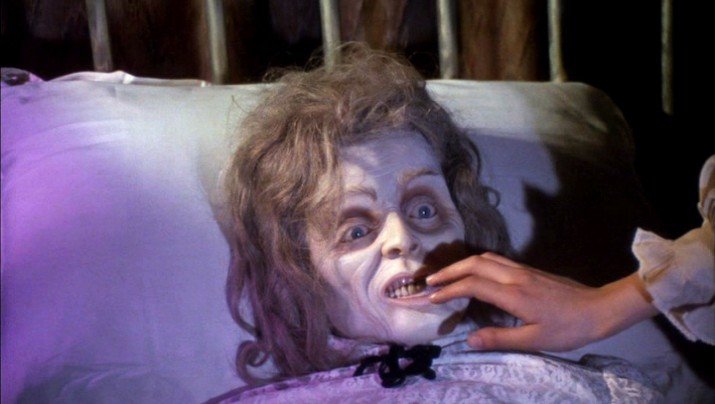
Case in point is the opening story, “The Drop of Water.” Structured like a Poe tale, it involves a “beyond the grave” revenge and the slow, steady torture of a person’s sanity. In a way, I suppose it is a rip-off of “The Tell-Tale Heart,” but it is still entertaining and frightening. A nurse is asked to tend to the newly deceased body of a medium. As the nurse is doing her duty, she sees an attractive ring on the finger of the corpse and relieves her of it. Immediately, she starts to become pestered by a fly. Though this is innocuous enough, it is when Nurse Chester returns to her apartment that the terror is ratcheted up to the Nth degree. She begins to hear water dripping from her bathroom faucet, echoing the drips of water she heard from a glass that was tipped over at the medium’s apartment. The fly also returns, continually buzzing around her. However, that is nothing compared to the images she sees of the medium, alternately in her bed, and walking toward her, with the most terrifying rictus grin I’ve ever seen. Though you can probably guess Nurse Chester’s fate, the nice capper on the story is the suggestion that this cycle will continue.
The second story is “The Telephone,” a revenge play that is a bit Hitchcockian in nature. Rosy is a Parisian escort (let’s be classy about this, shall we?) who begins to receive haunting telephone calls from her ex-pimp (ok, not that classy), Frank, who has just been released from prison. You see, Rosy was the one who was responsible for Frank going to prison, and he is now out to get her! Rosy calls her ex-lesbian lover, Mary, to comfort her, only to find out that it was a trick played by Mary in order to be reunited with Rosy. Of course, Frank actually does show up to have her revenge on Rosy, but kills Mary by mistake, leading to a final confrontation between Rosy and her assailant. In this simple story, Bava presents psychological and stalking terror at its best, all isolated in one location, and exploring the depths of evil that some will go to in order to either have companionship or revenge. Apparently, the cut American version removes the lesbian subplot, showing the hypocrisy that prostitution and murder is just fine, but love in a different form is taboo. Ridiculous.
The final story is “The Wurdalak,” adapted from an Aleksey Tolstoy tale (Leo’s cousin). Bava faithfully sets the scene in 19th century Russia, in which a young gentleman on a long journey comes across a headless corpse with a dagger in its chest. He removes the dagger and continues on, finding a cabin and a family inside. It turns out that the dagger belongs to the patriarch of the family, played by Boris Karloff, who had left previously to hunt the dreaded Wurdalak, a term that they define as a walking corpse who feeds on the blood of the living. In other words, this is a vampire story, though it shares certain elements with zombie tales as well. The father returns, having been turned into a Wurdalak himself, cleverly and heartlessly preying on the members of his family, one by one. This segment combines many standard elements of great horror, including the supernatural, undefeatable monster, the idea of that monster being someone close to you, the stranger caught up in accidental terror, the isolated cabin in the woods, and people being picked off one at a time.

Kwaidan (1964, Masaki Kobayashi)
First of all, let me say this: Kwaidan is a gorgeous film. This is apparent from the first few frames of the credits, with images of ink in water, creating an ethereal atmosphere. The rest of the film is just as mesmerizing. Like Black Sabbath, Kwaidan is made up of a series of short stories, these based on traditional Japanese ghost stories as told by Lafcadio Hearn. The first story is called “The Black Hair” and is not one that is easy to forget. A samurai leaves his wife and an existence of poverty because he simply wants more out of life. He marries again into wealth and status, but his second wife is selfish and awful. He goes back to his first wife, having somewhat realized his error, and while everything seems fine at first, he wakes up to find that his original companion has turned into just a skull and hair. In payback for his selfishness, he finds that he too has become older, and ghoulish in appearance. Though the story is simple, it takes its time to set a tone and an atmosphere, making the payoff that much more satisfying. Additionally, like the Hammer Horror films of the time, it uses a magnificent color palette for a genre that doesn’t generally use them.
The second story in called “The Woman of the Snow” and may seem familiar to those who have seen the 1990 film, Tales from the Darkside, which was originally intended to be Creepshow 3. A terrible snowstorm hits two woodcutters and they take shelter in a small hut. The titular woman of the snow comes, kills one of the woodcutters, then spares the other, telling him that he cannot utter a word about what happened, or she will know and punish him. The spared woodcutter later meets a pretty young girl and they fall in love. He, of course, tells her the story of the woman in the snow and his young wife reveals herself to be that woman. But, rather than killing him, due to their having children, she decides his punishment is simply leaving him. Due to their happy existence, the punishment seems to be enough, though she does say that if the children complain about her absence, she will come back to kill him. Again, the greatness of this story is how it is drawn out, much like a great story that is told around the campfire, as well as the amazing color and imagery presented throughout the telling.
“Hoichi, the Earless” is the third story, and it is a doozy. It begins with the epic poem, “The Tale of the Heike.” A young, blind monk has been secretly performing this epic poem at the behest of the ghosts who actually fought in the battle as portrayed in the song. The elder monks, sensing the danger of the situation, punish him, but also tattoo the young monk’s body with protective kanji. This, in effect, leaves him invisible to the ghosts who seek his singing and storytelling. By mistake, they leave the young monk’s ears unmarked. In a clever bit of special effects work, the ghosts come looking for the monk and see a pair of floating ears, which are soon cut off by the warrior ghosts.
The final story is “In a Cup of Tea,” which finds a samurai haunted by the image of a man in his, you guessed it, cup of tea. Even more samurai later haunt him and they eventually drive him mad. This tale becomes a two-fer as it stops in the midst of a battle between the haunted man and his ghostly assailants, revealing that it is being told by a heretofore-unseen writer who has decided to let the readers determine their own ending. The writer’s wife returns to find her husband has disappeared. She screams as she looks into his cup of tea and you can guess the rest. Kwaidan is definitely an expressionist film, with realism being put on the back burner for effect and atmosphere. Kobayashi uses artificial backdrops, images of eyes appearing in the simulated sky, and created landscapes in order to make the point that these stories are mythologies, fairy tales, or campfire stories, to be taken as artistic presentations. In this way, the film works on two levels, as moralistic mythology and as entertaining terror. Again, it is a gorgeous film and well worth the time.


