Showing posts with label Billy Wilder. Show all posts

Sunday, September 25, 2011

Films of the 60s, Part 19: Strange as Angels (The Worlds of Manic Pixie Dream Girls)

"You ... soft and only
You ... lost and lonely
You ... strange as angels
Dancing in the deepest oceans
Twisting in the water
You're just like a dream."

- The Cure, "Just Like Heaven"


Film Critic Nathan Rabin coined the term “Manic Pixie Dream Girl” after seeing Kirsten Dunst in Cameron Crowe’s Elizabethtown. His definition is, “that bubbly, shallow cinematic creature that exists solely in the fevered imaginations of sensitive writer-directors to teach broodingly soulful young men to embrace life and its infinite mysteries and adventures.”(1)(2) Since that time, the sobriquet has really taken off and become part of film culture, with characters played by the likes of Natalie Portman, Zooey Deschanel, and Kate Hudson. However, many critics have now gone back to mine film history for examples of this semi-cryptozoological / magical creature known in shorthand as the MPDG. The following is a survey of three films from the 60s that I consider to exhibit the properties of the Manic Pixie Dream Girl.


The Apartment (1960, Billy Wilder)

Billy Wilder had already proved himself a master filmmaker in several genres including noir and comedy, but The Apartment was his first Best Picture Academy Award win. It was also somewhat a blueprint for the Manic Pixie Dream Girl. Shirley MacLaine plays the MPDG in question, teaching Jack Lemmon’s character, C.C. Baxter, lessons about love and the important things in life. Heck, she even had a pixie cut to complete the whole package. The usual modus operandi for MPDGs is that they tend to have their heads in the clouds, are free spirits, but somewhat need to grow up. The men in their lives are, of course, attracted to this dreamlike naïveté, at first wanting to occupy the same world as the MPDG. Eventually, the femme’s bad choices get her into trouble and the homme gets to come to the rescue, but rather than both growing up and learning, they tend to succumb to their childish fantasies. This is somewhat true of The Apartment, though we are left wondering what the future may hold.

The premise of the film is that Baxter has an Upper West Side New York apartment that he lets his coworkers use as rendezvous spots for affairs in order to work his way up in an insurance company. One fateful day, he meets Fran, an attractive elevator operator and pursues her, only to find out that she is having an affair with Mr. Sheldrake, the personnel director, played by Fred MacMurray. Fran allows Sheldrake to string her along, preying on her naïve nature, professing his love, but still going home to his wife. Eventually, she is let down one too many times. In a scene that was later mirrored in Almost Famous, a film by Cameron Crowe, who seemingly perfected the MPDG mythos, Baxter saves Fran from overdosing. In the meantime, Baxter allows his neighbors and coworkers to believe the worst of him, even getting slugged in the face by Fran’s brother-in-law for his good deeds. Baxter eventually learns that the boys’ club at work is not worth it and would rather stand up for love than for advancement and respect.

MacLaine has quite a few moments of MPDG-ness, reciting dialogue that veers between a carefree attitude and self-hatred. For instance, looking into a broken mirror and saying, “I like it that way. Makes me look the way I feel.” All it needs in a modern remake is a Smiths song as background. She also shows her vulnerable heart to Baxter in relation to insurance statistics, feeling bad that because she doesn’t get colds, some other poor guy has to get five to meet the average. Exhibit C finds Fran yet again in a state of humor in her darkness, “I was jinxed from the word go. The first time I was ever kissed was in a cemetery.” What makes this film different from the typical MPDG scenario is that Lemmon is somewhat of a Manic Pixie Dream Guy for MacLaine as well, in effect reversing the roles. This film could easily be from Fran’s point of view with Baxter acting as the bubbly yin to her dark yang. His straining spaghetti through a tennis racket and odd turns of phrase, such as “That’s the way it crumbles…cookie-wise,” are illustrative examples of the possibility. But, it is really Baxter’s life that changes, going from corporate social climber to moral human being, whereas Fran remains fairly unchanged throughout, merely seeing something in Baxter after she has affected his life.


Breakfast at Tiffany’s (1961, Blake Edwards)

People either love or hate Breakfast at Tiffany’s and I don’t quite get the disparity. Sure, Mickey Rooney’s character is one of the most racist and politically incorrect portrayals in film history. Sure, the ending of the film is drastically different than Truman Capote’s novella. But, it is an iconic film, full of great performances, wonderful music, and the ultimate in Manic Pixie Dream Girls, Miss Audrey Hepburn. One could pick any one of several Audrey Hepburn films to support the MPDG thesis, but Breakfast at Tiffany’s captures it to an extent that the others just don’t reach. Because quite a few men, guilty as charged, see MPDGs as the dreamlike ideal, there are many of us who have had dalliances with our own Holly Golightlys, those girls who just seem too beautiful, effervescent, and charming to be real. And that’s the thing, they aren't real. There is always something roiling under the surface.

Holly Golightly is the MPDG for Paul, played by George Peppard, a down on his luck writer who has taken to becoming a boy toy for a wealthy mistress. To Paul, Holly has it all figured out. She is a Manhattan socialite with tons of connections, lush parties, and rich courters. Paul and Holly, each trying to find their way in their respective worlds, grow closer to each other. We sense that Paul has most likely fallen in love with Holly, though she remains aloof and blithe. Things begin to take a turn when the façade of her life starts to crumble, her former life as Lula Mae Barnes surfaces in the shape of her ex-husband from an annulled marriage, and her engagement to a wealthy beau is called off. This is when the truly MPDG moment happens, with Holly and Paul running around the city, taking turns doing things they have never done before. Who does this in reality? Very few, I think, in that it is purely a construct of the MPDG ideal.

In the book, Holly is somewhat of a call girl, or at least very free with her sexuality. The film version is nearly the opposite, though carefree, she is somewhat chaste, making her even more of a fictional construct. After all, isn’t this what every guy dreams about, a free spirit who is also virtuous? While purists who love the Capote novella feel the film’s ending is a betrayal and a travesty, there is no other way the film can end, and in effect, this is why it has become beloved. Paul could have easily continued his life as a down on his luck writer, resorting to life as a gigolo to survive, but instead, he is inspired by the magical Holly Golightly, eventually selling a short story, getting his life back in order, and believing in love. It is the Hollywoodiest of Hollywood endings, but is nonetheless satisfying. I’ve had my own Holly Golightly, so I know that the MPDG model exists, but my life didn’t end up like Paul’s. The truth is that while these magical females might exist, the guys whose lives they change are usually left behind, so many “Doc” Golightlys.


Jules et Jim (1962, François Truffaut)

By the time Jules and his friend Jim meet Catherine, they already believe she is magical, being a human representation of a statue they found eminently fascinating and beautiful. Catherine, played by Jeanne Moreau, does not disappoint them further, being the embodiment of the Manic Pixie Dream Girl, racing with them, jumping into rivers, and saying such things as “I don’t want to be understood.” Like Fran and Holly, she is a free spirit, but as opposed to the other two films, Truffaut finishes the story of what would happen when this type of free spirit gets tied down. When Catherine is allowed to just be herself with Jules and Jim, everything is fine. But, when Catherine marries Jules, things start to change. They have a child and start a family, but one gets the sense that Catherine was never cut out for settling down. Jules senses this as well and is therefore okay with her and Jim starting an affair, as he just wants her to be happy.

The truth is, however, that this occurrence is irreversible. While Catherine may have changed the lives of Jules and Jim, their desire to capture that spirit and bottle it forever essentially drained the magic of the MPDG. This brings to mind another issue and question. Are the actions of a Manic Pixie Dream Girl really just expressions of the wonder of life, or are they signs of bipolar disorder? One can make arguments on both sides, but only Truffaut provides concrete evidence for the latter. One could also make the argument that one simply shouldn’t try to pin down unconventional women into conventional lifestyles. As Holly Golightly says in Breakfast at Tiffany’s, “You musn't give your heart to a wild thing. The more you do, the stronger they get, until they're strong enough to run into the woods or fly into a tree. And then to a higher tree and then to the sky,” or “I'm like cat here, a no-name slob. We belong to nobody, and nobody belongs to us. We don't even belong to each other.”

Whereas Holly, Paul, Baxter, and Fran have different endings than Jules, Jim, and Catherine, or so we are led to believe, Truffaut finishes the story of the boy meets MPDG, boy is entranced by MPDG, boy loves MPDG with MPDG is smothered by boy trying to corral her into a world of harsh realities. Regardless, Jules and Jim is a phenomenally great film and Jeanne Moreau an enchanting, yet realistic version of a Manic Pixie Dream Girl. What no one told Jules and Jim is that, though she changed their lives for the better, the same rarely happens in reverse, even with two chances.


(1) Rabin, N. (2007). "My Year of Flops, Case File 1: Elizabethtown: The Bataan Death March of Whimsy." Retrieved from A.V. Club, The Onion.
(2) Bowman, D., Gillette, A., Hyden, S., Murray, N., Pierce, L., & Rabin, N. (2008). "Wild Things: 16 Films Featuring Manic Pixie Dream Girls." Retrieved from A.V. Club, The Onion.

Saturday, July 17, 2010

Films of the 50's Part 7: Audrey Hepburn


I admit it. I’m prone to crushes. Or, as Jule Styne and Sammy Cahn put it, in the sublime voices of Chet Baker and Frank Sinatra, I fall in love too easily. Just today, in watching the recent film When in Rome, I gained another crush, this time on comedienne / actress Kate Micucci. Sigh. And yet somehow, every crush I’ve harbored, every girl I’ve fallen for, each female I’ve shared a relationship with, has had one thing in common, an element of Audrey. I don’t know if I realized it until now. It’s only in hindsight that I’ve been able to piece together that Audrey Hepburn has been the Rosetta Stone for my love life. So, it was with great awe and reverence that my journey through the films of the 50’s found the movies of the exquisite Ms. Hepburn.

Roman Holiday (1953, William Wyler)

Is it coincidence to go from the aforementioned When in Rome to Roman Holiday? Honestly, it is coincidence. While When in Rome did film a small bit of footage in Rome, Roman Holiday was filmed completely in that magical city. Rome itself becomes a character. But, this film is truly owned by Audrey Hepburn and Gregory Peck, two giants of the silver screen. Hepburn and Peck still had to wait a few years, until the early 60’s, to portray the roles that would define them (in my opinion, Breakfast at Tiffany’s and To Kill a Mockingbird, respectively), but it was easy to see just how magnetic these two were together in Roman Holiday. Peck was already a veteran of Hollywood. Hepburn had done a few small films, but Roman Holiday was, for all intents and purposes, her big screen debut.

Hepburn plays Ann, or Anya as she reveals herself to Joe, played by Peck, the princess of a country that is never named, on tour throughout the major cities of Europe. In Rome, she has a kind of breakdown, escaping the confines of her quarters and her handlers. She meets Joe Bradley, a reporter, who finds her asleep on a bench. Though Joe soon figures out her true identity, he can’t help but fall in love with her. They spend time together having as ‘normal’ a life as this princess has ever had. And though Ann eventually returns to her life of royalty, we are left with coded messages between the two that will tug at the tautest of heartstrings.

It’s no wonder that I, along with many others, fell for Audrey. She is at once elegant, aloof, charming, silly, radiant and unbelievably beautiful. Roman Holiday introduced to the world a stunning vision and incredible talent, and it’s a damn fine movie, too. To top it off, Hepburn won the BAFTA, the Golden Globe, and the Oscar for her role as Ann. Special mention also has to be given to Eddie Albert, brilliant comic relief in this highly romantic film.

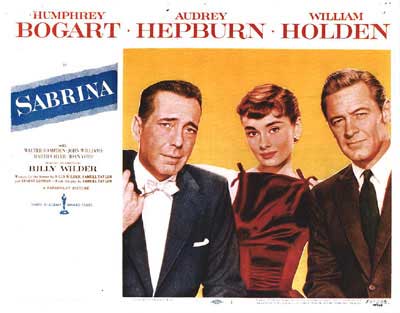
Sabrina (1954, Billy Wilder)

There’s a bit of a leap in logic viewers have to take at the beginning of Sabrina. As Hepburn, playing the title role, sits in the crook of a tree, crushing on William Holden’s David Larrabee, we are to believe that she is awkward and unattractive. It’s a bill of sale given to us by Hollywood time and again. Except this time, we didn’t even get the courtesy of the glasses and overalls, such as in She’s All That. Instead, Hepburn is unintentionally dreamy from the first second she appears on screen, a creature so enchanting that no man, no matter how rich or experienced, could possibly resist her.

Regardless, according to the story, Sabrina is sent off to culinary school in Paris, learning about the ways of cultured life. She comes back, and is somehow unrecognizable to David. But, David is engaged to a very rich heiress, and older brother Linus feels the need to intervene in a possible fledgling relationship. In the process, Linus, played by Humphrey Bogart, himself falls for Sabrina.

Though the age difference was substantial, it’s hard to deny the sparks between Bogart and Hepburn. (The same could be said without the age difference for Bogart and another Hepburn in the earlier film, The African Queen). Each part is expertly cast, with Holden playing the role of the selfish playboy exceedingly well. Billy Wilder had yet another magnificent film on his hands with Sabrina, and Audrey Hepburn further cemented her status as the thinking man’s fantasy girl.

Funny Face (1957, Stanley Donen)

I’m not normally a fan of musicals. Very few films of the genre have done much to change my mind (though I have not yet written about Singin’ in the Rain). The biggest problem I have with musicals is the idea of characters breaking into song in the midst of ordinary situations, a problem that Singin’ in the Rain handles with ease. While this movie doesn't quite avoid that trope, Stanley Donen proves once again he is a master of the genre. Funny Face is a virtual feast for the eyes and ears. Images by Richard Avedon, vivid colors, and classic tunes by George and Ira Gershwin all combine to make a film that would be remembered, even if not for the inclusion of Audrey Hepburn. But, she took it to another level.

First of all, we are again given the same unbelievable pablum that Hepburn can somehow be made to appear unattractive. But, as a literature loving bookstore clerk, Hepburn had me falling all the harder. In fact, I found her more appealing and attractive in these clothes than her eventual fashion plate makeover duds. In another similarity to Sabrina, the story pairs Hepburn with an older man, in this case Fred Astaire, thirty years her senior. Astaire plays Dick Avery, a photographer, who plucks Jo Stockton (Hepburn) from her beatnik-like lifestyle and introduces her to the sophisticated world of fashion. They, of course, fall headlong for each other.

With Astaire in tow, you know there are going to be some beguiling dance scenes, and in that realm, Funny Face does not disappoint. His “umbrella and cape” dance routine to “Let’s Kiss and Make Up” is riveting, while his duet with Kay Thompson (yes, the later author of the Eloise children’s books) is a bit silly but highly entertaining. Never have I seen, outside of Happy Days, the beatnik scene so cartoonishly portrayed. But the true centerpiece of Funny Face is the Bohemian, black bodysuit dance by Hepburn in a Paris nightclub. The scene was later put to AC/DC and put in a Gap ad, showing the power of Hepburn’s appeal. My favorite Hepburn movies were filmed in the 60’s, but I could watch her early work in the 50’s repeatedly, most likely falling in love too easily, all over again.

Sunday, June 20, 2010

Films of the 50's Part 3: Dial M for Murder & Ace in the Hole

(Note: The author apologizes for this, previous and future posts, which might not be written or edited to the best of his ability. These are meant as quick snapshot reactions to films, and are limited by time. Thank you.)


Dial M for Murder (1954, Alfred Hitchcock)

Alfred Hitchcock could end up with six movies or more on my list of the best films of the 50’s. I constantly change my mind as to which of his films is my favorite. I just can’t do it. Dial M for Murder is one of those that I can watch again and again. One can easily tell from the lack of location changes that Dial M was adapted from a stage play, much like another of my favorites, Rope. We also find out that Hitchcock has a thing for murderous tennis players, as both this and Strangers on a Train use this unlikely character type.

Ray Milland plays Tony Wendice, a cuckolded former tennis pro. Grace Kelly plays Margot, his cheating wife. Wendice sets out on the path of revenge, hatching a plan as intricate as a Rube Goldberg device. As can be expected, the plot to have his wife dispatched does not go as smoothly as he once hoped, and he must improvise. The interplay between Milland and Kelly is remarkable. The constant game of deception and does he / she know keeps the viewer teetering as if on an unraveling tightrope.

Pivotal scenes revolve around small objects, a pair of scissors, a key, an attaché case. Some might call these Hitchcock’s classic “MacGuffins,” items that are there to propel the story forward with no real meaning otherwise. Hitchcock wrings suspense out of every moment. Case in point, Chief Inspector Hubbard’s quiet search for the key, and as a result his piecing together of just what happened the night Wendice paid someone to have his wife murdered.

There are two of Hitchcock’s films that have masterpiece posters, Vertigo and Dial M. The former, the work of Saul Bass, is iconic, geometrical and simple. The latter is its opposite, deep blood red, visually realistic; the pleats of Grace Kelly’s dress vivid and somehow surreal. Kelly’s hand reaching out, the phone off the hook nearby, was probably meant as a cue that the film was originally meant to be presented in 3-D, but forgotten since viewers lost interest in the format, and it was rarely seen this way.


Ace in the Hole (1951, Billy Wilder)

This is one of a handful of films I’ve seen that ended up tanking at the box office, and sometimes also critically, yet over time finding itself heralded a classic. Ace in the Hole was most likely expected to be as big a hit as the auteur’s previous films, Double Indemnity, The Lost Weekend, and Sunset Boulevard. Unfortunately, that didn’t turn out to be the case.

Ace in the Hole tells the story of Chuck Tatum, a newspaper reporter down on his luck and lacking scruples, finding himself with no other prospects than a low paying job on a small newspaper in New Mexico. After a year of failing to get his big story and making it back to the big city, Tatum begins to despair. On a routine assignment, he and the young photographer in his tow come upon a remote general store where they find that a man has been trapped in the depths of a nearby mine. Seizing opportunity, Tatum sticks around and begins to sensationalize the story, even going to the lengths of convincing the rescue crew of using the slowest method of reaching the trapped miner in order to make the most of the story.

The story gains notoriety and national coverage. Gawkers begin to show up, until eventually, the whole affair becomes a mockery of itself, with a carnival and amusement rides established in the flats near the mine. Wilder wanted to take the media to task, but viewers at the time didn’t seem to get it. It has gained classic status today because of the carnival-like media today. The recent following of the ‘balloon boy’ story is just one example.

In true Wilder style, the title is fantastically clever, and yet, the studio changed the title before its release in theaters to The Big Carnival. Kirk Douglas’ over the top performance is perfect for the role and the message of the film. His ego and quest for personal gain drives every scene. One nice little touch I’ll always remember is that he refers to everyone as ‘fan.’ How’s that for humility? I'm sure there were many who might not have known that the Simpsons episode, "Radio Bart," in which Bart throws a radio / walkie talkie down a well, then gets himself trapped in it, was directly inspired by this film.

Wilder was one of the country’s most notable early multiple threats: writer, director, producer. Above all, he was a writer, and a damn good one, which is why one foreign director said, for his Oscar acceptance speech, “I would like to believe in God in order to thank him. But, I just believe in Billy Wilder.” Further, on Wilder’s gravestone, it reads one of my favorite quotations, “I’m a writer. But then, nobody’s perfect.”